
Dragon Tiger: Why the Tie Bet Is Far Riskier Than Dragon or Tiger
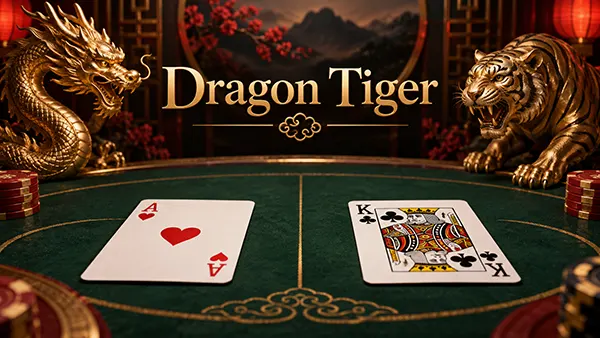
Dragon Tiger looks unusually simple: one card is dealt to Dragon, one to Tiger, and the higher rank wins. That simplicity can make the three main betting choices appear more similar than they really are. Dragon and Tiger are near-mirror images of each other, while Tie is a fundamentally different wager. It wins much less often and relies on a larger payout to compensate for that low hit rate. Under a widely used eight-deck rule set, a Tie occurs on roughly 7.47% of deals, compared with about 46.27% for a Dragon win and 46.27% for a Tiger win. The difference becomes even more important once the paytable is considered. A Tie paying 11:1 still carries a substantially higher mathematical disadvantage than a standard Dragon or Tiger bet when tied main bets lose half the stake. Some versions offer only 8:1 on Tie, making the difference far larger. Understanding those figures is more useful than judging the bets simply by the size of the displayed payout.
How Dragon Tiger Settles Dragon, Tiger and Tie Bets
Traditional Dragon Tiger uses ordinary playing cards and compares rank rather than poker hands. Each side receives a single card, with Ace normally treated as the lowest rank and King as the highest. Suits do not decide which side wins. If Dragon receives a Queen and Tiger receives a Nine, Dragon wins; if Dragon receives a Four and Tiger receives a Jack, Tiger wins. When both cards have the same rank, such as two Eights of different suits, the result is a Tie. There is no need to total card values, draw extra cards or make playing decisions after the initial wager. This gives Dragon Tiger fewer moving parts than baccarat or blackjack, but the simplicity of the round does not mean every available wager has comparable odds.
Dragon and Tiger normally pay 1:1. A £10 winning bet therefore produces £10 in profit plus the return of the £10 stake. The important rule is what happens when both cards have the same rank. Under a common Dragon Tiger structure, a player who backed Dragon or Tiger loses half of the main stake on a Tie rather than losing the entire amount. A £10 Dragon bet would therefore lose £5 if the cards tied. That rule is one reason the mathematical cost of the two main bets stays relatively moderate. It is still a negative-expectation casino bet, but its disadvantage is much smaller than the disadvantage attached to many Tie paytables.
A direct Tie wager works differently. It loses whenever the ranks are different and pays only when both cards match in rank. Current live-casino versions do not all use exactly the same paytable, so the rules displayed at the individual table matter. Evolution, for example, lists an 11:1 payout for its standard Tie bet and 50:1 for a separate Suited Tie. Other Dragon Tiger versions have historically used 8:1 for an ordinary Tie. Those numbers may look attractive beside a 1:1 main-bet payout, but payout size on its own says nothing about value. It must be compared with how rarely the winning event occurs.
Why a Bigger Tie Payout Does Not Mean Better Value
The most common misunderstanding about the Tie bet comes from focusing on the possible win rather than the relationship between payout and probability. Winning £110 from a £10 wager at 11:1 is clearly more striking than winning £10 from a £10 Dragon bet, but the Tie must occur often enough for that higher reward to compensate for all the losing rounds between wins. In an eight-deck game, that does not quite happen. After one card has been dealt, there are 415 cards left. Only 31 of them have the same rank as the first card, because eight decks contain 32 cards of each rank and one matching-rank card has already been removed. This produces a Tie probability of approximately 7.47%.
The corresponding fair payout would have to be roughly 12.39:1 for a wager with no mathematical house advantage under that simple eight-deck calculation. An 11:1 payout therefore falls below the fair-price level. The difference may not look enormous on the table display, but over a large volume of wagering it produces a house edge of about 10.36%. If the same Tie pays only 8:1, the gap becomes much greater and the house edge rises to about 32.77%. That is why checking the actual payout is essential: two tables can use the same basic Dragon Tiger rules while giving the Tie bet very different long-term characteristics.
Dragon and Tiger do not offer a large headline payout, but the winning probability is far higher. In the standard eight-deck model, Dragon wins approximately 46.27% of all deals and Tiger also wins approximately 46.27%. The remaining 7.47% are ties. With even-money wins and a half-stake loss when a Tie appears, either main bet has a house edge of about 3.73%. Dragon is not inherently better than Tiger, and Tiger is not inherently better than Dragon; their probabilities are symmetrical. The meaningful comparison is therefore between either main side and the Tie. An 11:1 Tie has nearly three times the house edge of the standard main bet, while an 8:1 Tie is dramatically more expensive mathematically.
The Probability and House Edge Behind the Tie Bet
The difference becomes clearer when the percentages are translated into a large sample of rounds. Over 1,000 theoretical deals using the standard eight-deck probabilities, roughly 463 would be expected to favour Dragon, another 463 to favour Tiger and about 75 to finish as ties. Real results will not follow those numbers exactly, especially over a short session, but the example shows the scale of the imbalance. Someone betting on Tie is effectively backing an event that fails on around 925 of every 1,000 deals in the long run. A player repeatedly backing Dragon or Tiger faces a much more balanced distribution between full wins and full losses, with the smaller group of ties normally costing only half the stake.
House edge expresses the average mathematical loss as a proportion of all money wagered over a very large number of rounds. At a 3.73% edge, £1,000 of total Dragon or Tiger wagers represents a theoretical long-term loss of about £37.30 under the standard rules. At a 10.36% edge, the same £1,000 wagered on an 11:1 Tie corresponds to about £103.60. If the Tie pays 8:1 and carries a 32.77% edge, that theoretical cost rises to roughly £327.70 per £1,000 wagered. These are not forecasts for an individual session. A player can finish far above or below the theoretical figure over 20, 50 or even several hundred rounds. The figures are useful because they allow different bets to be compared on equal terms.
The 11:1 Tie therefore presents two separate forms of risk. First, the expected loss is higher than on Dragon or Tiger. Second, results are much more volatile because most wagers lose completely and occasional wins are comparatively large. Those two ideas should not be confused. A wager can be volatile without having an exceptionally high house edge, and it can have a high house edge without producing huge swings. Tie combines both characteristics to a meaningful degree. This can make short sessions deceptive: one early Tie win may put a player well ahead, while a long sequence without a Tie can consume many stakes before the larger payout appears.
What Tie Volatility Looks Like Across Repeated Rounds
A Tie probability of about 7.47% is sometimes interpreted as meaning that a Tie should arrive once every thirteen or fourteen rounds. That is not how random card results work. The figure describes a long-run average, not a timetable. Nothing requires the next round to produce a Tie simply because the previous ten rounds did not. As a simple probability illustration, treating successive rounds as having the same approximate 7.47% Tie rate gives about a 46% chance of seeing ten consecutive rounds with no Tie at all. The approximate chance of twenty rounds without one is still about 21%, and thirty rounds without one is close to 10%. Actual shoe composition changes as cards are dealt, but the illustration shows why Tie losing runs should not be considered unusual.
This is also why staking systems cannot turn an unfavourable Tie paytable into a favourable wager. Increasing the stake after several non-ties does not make the next pair of cards more likely to match ranks merely because the recent sequence has been one-sided. A progression can create the appearance of recovering previous losses when a Tie eventually lands, but it also causes exposure to grow during exactly the sort of losing sequence that a low-frequency bet can naturally produce. Table limits and available bankroll eventually prevent any progression from continuing indefinitely. The underlying payout and probability remain the same.
The same warning applies to road maps, result histories and streak displays commonly shown beside live Dragon Tiger tables. They are useful records of what has already happened, but a visual pattern does not alter the mathematical value of the next wager. A run of Tiger results does not force Dragon to appear, and a long absence of ties does not make a Tie overdue in a way that guarantees better value. Card depletion can cause small changes within a physical shoe because dealt cards are no longer available, but that is different from assuming that past outcomes create a compensating pattern. For most players, the much more practical information is the paytable, the Tie rule applied to Dragon and Tiger, and the amount being risked per round.
How to Compare Dragon, Tiger and Tie More Rationally
For someone choosing strictly on mathematical cost under the common eight-deck rules, Dragon and Tiger are equivalent and both are preferable to a Tie paying 11:1 or less. This does not mean either main bet can generate a positive long-term expectation. A house edge of about 3.73% still means the rules favour the casino over sufficiently large wagering volume. It simply means the disadvantage is lower. Choosing between Dragon and Tiger can therefore be treated as a symmetrical choice rather than an attempt to identify a statistically superior side. The important decision is often whether to remain with a main bet at all or accept the greater variance and higher expected cost of Tie.
Stake size also matters because Dragon Tiger can be fast. A modest amount per round can become a much larger total turnover when dozens of rounds are played. For example, 100 bets of £10 create £1,000 in total wagering even if the player’s starting balance was far below £1,000 because returned funds may be wagered again. At a theoretical 3.73% edge, the standard Dragon or Tiger bet represents about £37 of expected loss on that turnover. An 11:1 Tie represents about £104, and an 8:1 Tie about £328. The actual balance after 100 rounds could differ sharply, but turnover explains why a relatively small difference in house edge becomes important during repeated play.
The clearest way to treat Tie is as a high-variance side choice rather than as an equal alternative to Dragon and Tiger. Its larger payout is the compensation for a much lower hit rate, not evidence that it offers a stronger return. A player who still chooses it can keep the exposure proportionate rather than assuming the next Tie will recover earlier losses. Fixed stakes, predetermined spending limits and a clear stopping point do not change the house edge, but they do prevent the mathematical disadvantage from being magnified by uncontrolled increases in wager size. Gambling should be treated as paid entertainment rather than a method of earning money or recovering previous losses.
Checks to Make Before Placing a Tie Bet
The first check should always be the table’s exact Tie payout. An 11:1 Tie and an 8:1 Tie are not minor variations of the same wager from a value perspective. Using standard eight-deck probabilities, the estimated house edge changes from about 10.36% at 11:1 to about 32.77% at 8:1. A higher advertised multiplier can also belong to a different bet entirely. Evolution’s current Dragon Tiger information, for example, distinguishes an ordinary Tie paying 11:1 from a Suited Tie paying 50:1. The Suited Tie requires both rank and suit to match, making it much rarer. Comparing only the payout figures without reading the winning condition can therefore give a misleading impression of risk.
The second check is how ordinary Dragon and Tiger wagers are treated when the cards tie. The familiar calculation of roughly 3.73% assumes that a Tie costs half of a Dragon or Tiger stake. If a particular game uses a different settlement rule, its return changes. The number of decks and any unusual game rules can also affect the exact figures. For that reason, published percentages should be linked to a stated ruleset rather than presented as universal values for every game carrying the Dragon Tiger name. Current game information or the rules panel at the table should take priority over assumptions based on another provider’s version.
The final comparison is straightforward. Under the widely used eight-deck structure, Dragon and Tiger each win about 46.27% of all deals, while a Tie occurs about 7.47% of the time. With half the main stake lost on ties, Dragon and Tiger produce a house edge of approximately 3.73%. An ordinary Tie paying 11:1 increases that edge to around 10.36%, and an 8:1 payout pushes it to about 32.77%. The larger Tie payout therefore comes with both a lower frequency of wins and, at common paytables, a greater long-term mathematical cost. That is the central reason Tie is considerably riskier than choosing Dragon or Tiger, even though a single successful Tie can produce the largest immediate profit of the three main wagers.
Most popular
-
 Roulette with Track High by Playson
Roulette and its many varieties are now appealing to many gambling enthusiasts. And in 2018, Playson presented …
-
 Heroic Spins Slot Game Review
The Heroic Spins slot game has captured the attention of many gambling enthusiasts since its release. Launched …
-
 Review of Fruit Mania Deluxe Slot from Gamomat Provider
Fruit Mania Deluxe, developed by Gamomat, is a vibrant online slot game that captures the essence of …