
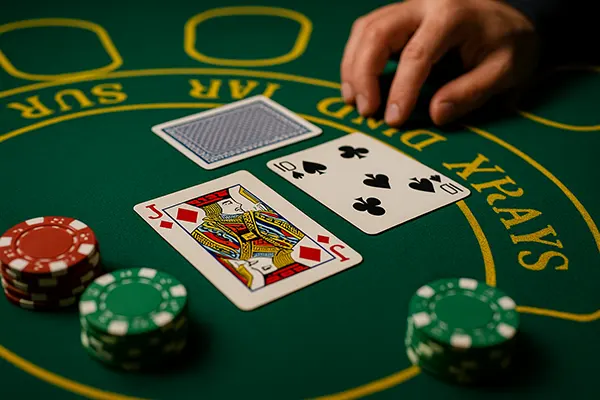
How the Basic Strategy in Blackjack Works: A Probability-Based Breakdown
The basic strategy in blackjack is a mathematically grounded decision system that guides players on the statistically optimal move in every possible scenario. Its logic is based on long-term simulations, probability theory, and analysis of dealer behaviour under the fixed rules of the game. By following these guidelines, a player reduces the house edge to the minimum level achievable without card counting. The strategy does not guarantee profit, but it ensures that every decision is supported by the strongest available data rather than intuition.
The Mathematical Foundation Behind the Basic Strategy
Blackjack is one of the few table games where player decisions influence the final outcome. The mathematical base of the basic strategy relies on calculating the expected value of every possible action. Expected value shows how much a player should statistically win or lose per unit wagered when a specific decision is repeated over thousands of rounds. These calculations consider the probabilities of drawing certain cards, the dealer’s fixed rules and the composition of the deck.
At the centre of the system lies a comparison between the player’s total and the dealer’s up-card. Certain combinations produce predictable outcomes; for example, a dealer showing a 6 is far more likely to go bust than one showing a 10. These tendencies allow players to adjust their behaviour according to risk levels. As a result, choices such as standing on a strong total or hitting on a weak one follow a logical pattern grounded in long-term statistical evidence.
The figures used to build the basic strategy come from millions of simulated rounds using exact probabilities. These simulations evaluate each potential action, measure its expected loss or gain and identify the statistically strongest path. The strategy chart that modern players use today is essentially a condensed map of these probabilities, making a complex mathematical system accessible at a glance.
Probability Patterns That Shape Player Decisions
The basic strategy is strongly influenced by the likelihood of the dealer completing different totals. Under standard rules, the dealer must draw to 16 and stand on 17, which creates predictable probability curves. For example, the dealer will bust approximately 42% of the time when starting with a 5, compared to only around 23% when starting with a 10. These percentages allow the player to decide whether taking additional risk is worthwhile.
The probability of the player drawing a beneficial card is also central. With a total of 12, the chance of busting with one additional card is roughly 31%, meaning that the decision to hit or stand depends heavily on the dealer’s up-card. When the dealer shows a strong card, the mathematical risk of standing outweighs the risk of drawing a poor card.
These probability patterns demonstrate that the logic of basic strategy is not arbitrary. Every recommended action comes from a comparison of the player’s risk with the statistical advantage gained by forcing the dealer to complete their mandatory draw sequence. When both factors are evaluated together, probabilities support decisions that minimise losses over thousands of rounds.
How Player Totals Influence Optimal Decision-Making
Player totals fall into several categories: hard hands, soft hands and pairs. Each behaves differently from a probability standpoint. Hard hands, which contain no Ace counted as 11, have limited flexibility. A hard 16 is a weak hand with a significant chance of busting when hit, yet often too low to stand against a strong dealer card. In these situations, probability analysis shows that taking the risk of drawing another card is statistically less damaging than allowing the dealer to complete a likely winning total.
Soft hands give the player additional safety because the Ace can shift between 1 and 11. This flexibility dramatically changes the expected value of many decisions. For example, a soft 18 may be a strong hand against a dealer’s low card but becomes significantly weaker against a dealer’s 9 or 10. Mathematical models show that hitting in such cases increases the chance of improving the hand without the risk of busting.
Pairs introduce yet another layer of probability-driven decision-making. Splitting is recommended when the long-term statistical gain from creating two separate hands outweighs the expected value of keeping them together. Splitting 8s and Aces is almost always favourable because simulations show that these combinations perform better when played as two new hands, even if the initial wager effectively doubles.
Why Certain Totals Require Specific Actions
Some decisions in basic strategy might appear counter-intuitive without understanding the underlying probabilities. For example, hitting a hard 12 against a dealer’s 3 may seem risky, yet probability tables show that standing results in a larger long-term loss. The dealer is less likely to bust with this up-card, and the player benefits more from trying to improve their weak total rather than hoping for a rare outcome.
Doubling down is another action supported by strong statistical evidence. When the probability of improving a specific hand outweighs the risk of drawing a weak card, the expected value of doubling becomes positive over time. A classic example is doubling on 11 against any dealer card except an Ace. Simulations repeatedly confirm that the long-term return gained from taking one forced card outweighs the additional wager.
Standing on certain totals is equally influenced by risk-reward analysis. A hard 17 or higher has a strong probability of winning or pushing without additional action. Any attempt to improve these hands statistically leads to more losses than gains. Probability theory therefore supports standing as the most efficient decision for preserving value over time.
Dealer Behaviour and Its Impact on Strategy
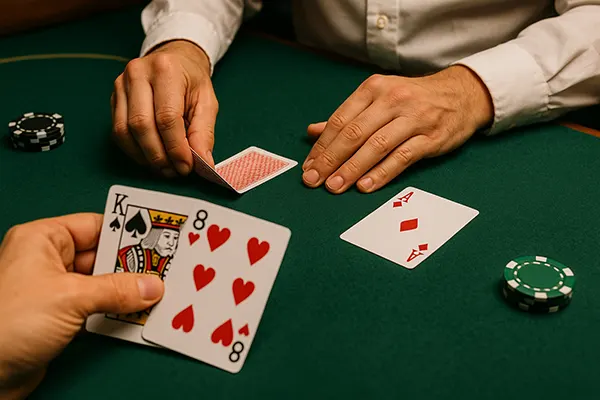
The dealer’s fixed rules are a major reason why the basic strategy is so effective. Unlike the player, the dealer has no freedom to change decisions. This predictable pattern allows probability experts to run simulations that determine the likelihood of dealer outcomes under specific card combinations. The consistency of these rules reduces the number of variables in each calculation, making the system highly reliable.
Dealer bust rates vary depending on the up-card. Low cards such as 4, 5 and 6 significantly increase the chance of the dealer exceeding 21 due to their obligation to draw until reaching at least 17. This risk shift plays a crucial role in basic strategy. When the dealer is more likely to bust, the player benefits from standing on weaker totals and avoiding unnecessary risk.
Conversely, high cards such as 9, 10 and Ace give the dealer a stronger statistical position. In these cases, basic strategy recommends taking more active measures, such as hitting on marginal totals or doubling when the expected value becomes advantageous. The approach is not based on guessing; the decisions reflect long-term probabilities that favour specific outcomes depending on the dealer’s visible card.
Why Dealer Rules Strengthen Probability-Based Decisions
The strict nature of dealer rules ensures that probability patterns remain stable from year to year. These patterns have been analysed since the mid-20th century and continue to hold true in 2025 regardless of the number of decks or typical rule variations. This stability allows the basic strategy to remain accurate across most regulated blackjack tables, provided that the rules follow the standard draw-to-16 and stand-on-17 system.
Because the dealer cannot adjust their behaviour, the player’s decisions have disproportionate importance. Each choice the player makes can either reduce or increase the house advantage. Probability calculations demonstrate that even small deviations from the basic strategy increase expected losses. This is why players who rely on instinct rather than probability often face worse outcomes over time.
Ultimately, the dealer’s restricted decision pattern is the foundation that allows the basic strategy to exist. Without these rules, simulations would be inconsistent and probability curves would lose their stability. The uniformity of dealer behaviour ensures that mathematical models remain accurate and that each recommended action retains its statistical justification.
Most popular
-
 The Wild Gang Slot Game: A Thrilling Adventure in Gaming
Dive into the excitement of ‘The Wild Gang’, a captivating slot game that has garnered widespread attention …
-
 Castle of Fire Slot Game: A Journey of Mythical Adventure
Castle of Fire, an enthralling slot game, was introduced to the online casino world in 2023, capturing …
-
 Patagonia Wild Slot: The Beauty of Nature on Reels
From the dense forests to the towering peaks, Patagonia has always captivated imaginations worldwide. Now, with the …